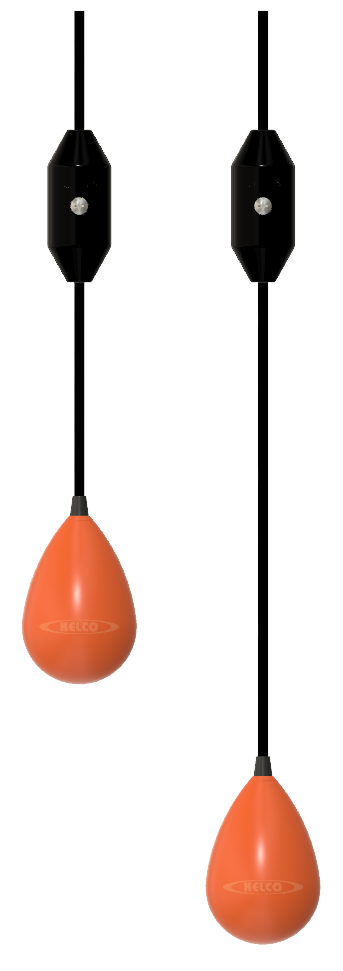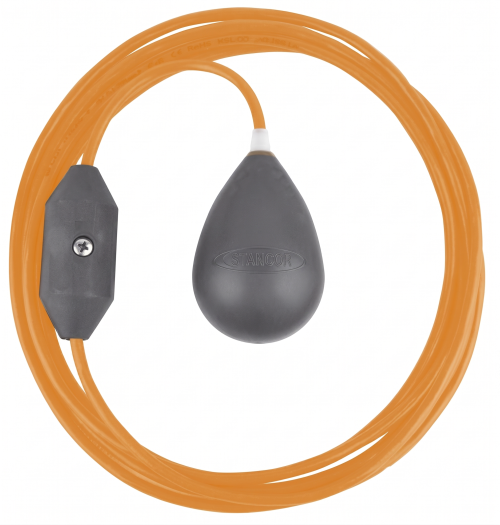
Larger, beefier sibling of the K Series — heavy duty polypropylene float fully overmoulded around a high quality three core cable. Heavy duty S.P.D.T. microswitch rated 21 A at 250 V AC, able to directly control small pump motors. Sealed, tamper-proof, no metal parts in contact with the liquid and highly chemical-resistant.
Q Series
Float Switches
Features
- Heavy duty 21 A Omron microswitch (250 VAC resistive)
- Extra-strong polypropylene float
- S.P.D.T. three-wire switch
- No mercury or lead components
- High-quality CPE rubber cable
- No metal parts in contact with liquid
- Sealed tamper-proof design
- Highly chemical resistant
- Wide range of cable sizes available
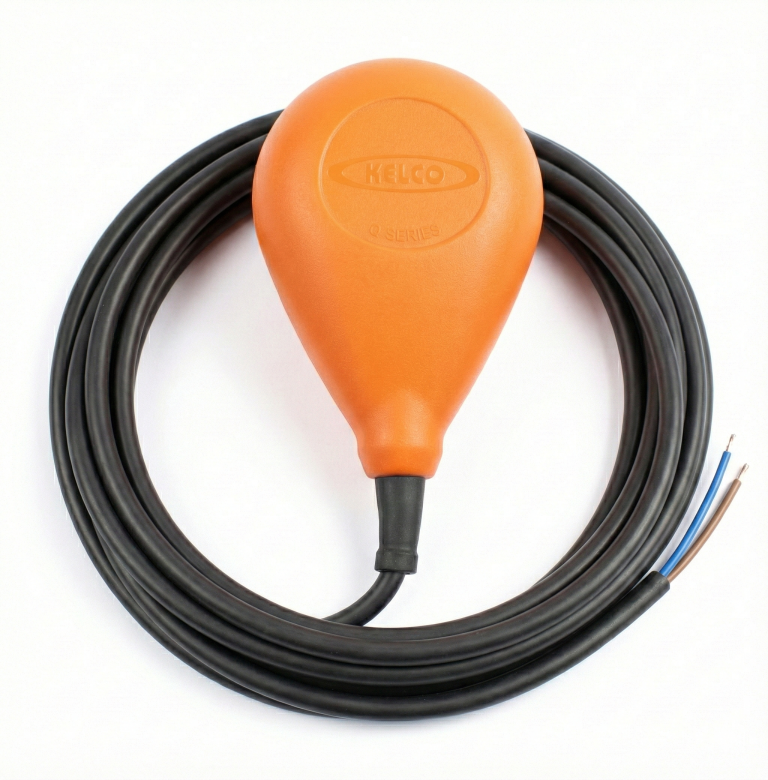
The Q Series float switch consists of a heavy duty polypropylene float fully overmoulded around a high quality three core cable. The float contains a single pole double throw (S.P.D.T.) switch which trips when the float tilts — it gives adjustable control over the level of liquid in tanks, pits and dams, and careful tethering of the cable sets the on or off action at any desired position. The heavy duty switch can directly control small pump motors (minimum load 160 mA at 5 V DC). The float is high grade polypropylene, fully overmoulded with no external gland, and the switch terminations are encapsulated in polypropylene to stop water tracking along the conductors. The sealed, seamless and glandless float is totally tamper-proof and extremely tough. The specially manufactured heavy duty cable is EPR insulated and CPE sheathed, and is designed for permanent immersion in water. The switch and cable are also resistant to oil, grease, fat, sewage and a variety of chemicals.
Select Model
Trade customers should contact sales@kelco.co.nz for account pricing.
Ordering — Available Models
| Model Number | Description |
|---|---|
| Q10M | Q Series float switch — 10 m of CPE cable (most common) |
| Q15M | Q Series float switch — 15 m of CPE cable |
| Q20M | Q Series float switch — 20 m of CPE cable |
| Q30M | Q Series float switch — 30 m of CPE cable |
| Q4M | Q Series float switch — 4 m of CPE cable |
| Q50M | Q Series float switch — 50 m of CPE cable |
| Q6M | Q Series float switch — 6 m of CPE cable |
| QCW |
Operating Limitations
| Maximum submergence | 30 m / 300 kPa static pressure |
|---|---|
| Maximum liquid temperature | 60 °C |
| Minimum liquid temperature | -20 °C |
| Liquid specific gravity | > 0.82 |
| Liquid pH range | 1 to 14 |
| Smallest well diameter | 600 mm |
| Liquid level change for switch operation | 300 mm (approximately) |
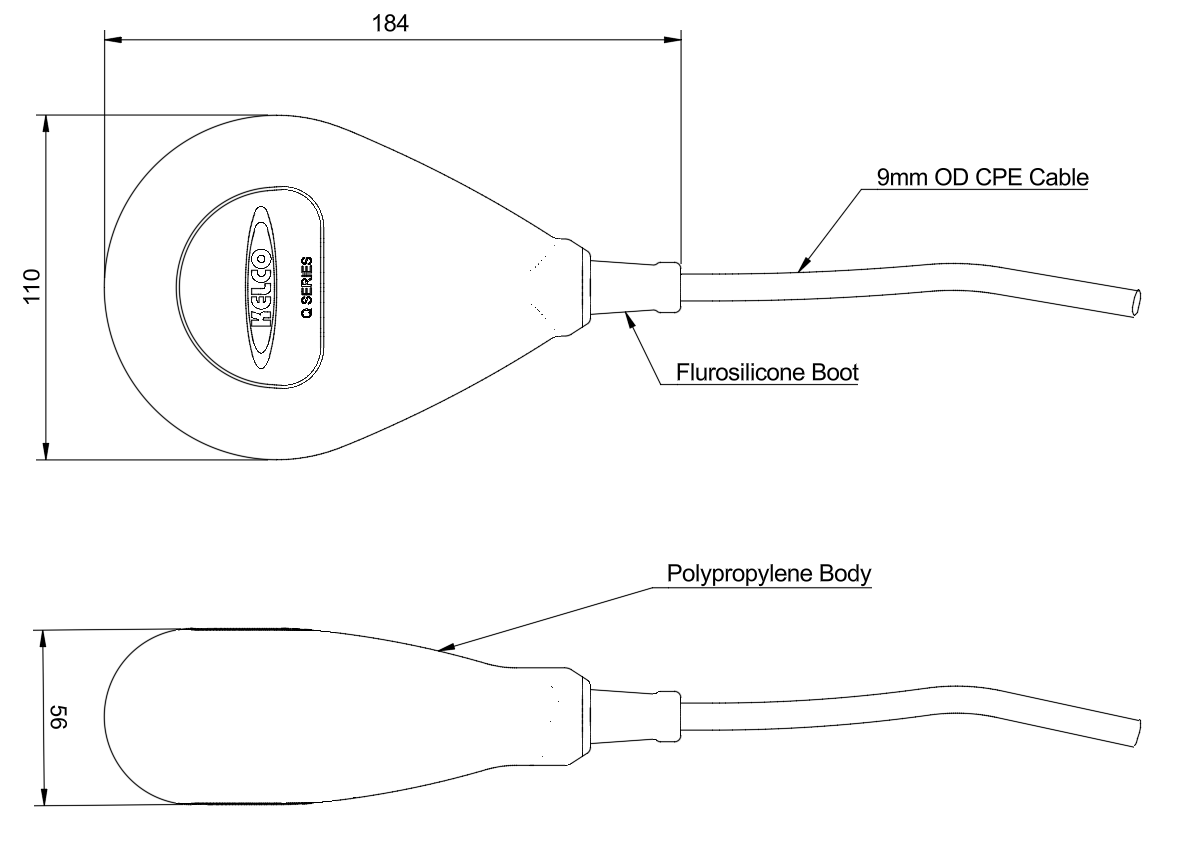
| Smallest opening through which the switch will fit | 108 mm |
| Minimum distance from float to closest tether/weight | 100 mm |
| Liquid level change with cable weight mounted 100 mm from float | 170 mm (300 mm maximum with no cable weight) |
| Suitability — sodium hypochlorite | Fully compatible |
| Suitability — sea water | Fully compatible |
| Suitability — potable water | Not approved |
| Maximum suspended length | Approx. 40 m (cable only) |
| Minimum cable bend radius | 6 × overall diameter (54 mm) |
Electrical Data
| Switch type | Single-pole double-throw, silver-alloy contacts, 1 mm gap |
|---|---|
| Rated voltage | 250 V AC; 125 and 250 V DC (low voltage recommended) |
| Resistive AC current rating | 21 A at 250 V |
| Motor load AC current rating | 4 A at 250 V AC |
| Mechanical life expectancy | 50 000 000 operations minimum |
| Electrical life expectancy | 100 000 operations minimum |
| Resistive DC current rating | 0.6 A at 125 V DC, 0.3 A at 250 V DC |
| UL rating | 21 A, ½ HP at 125/250 V AC |
| Minimum applicable load | 160 mA at 5 V DC |
| Low-current inputs | The 160 mA at 5 V DC minimum is the microswitch manufacturer’s rating for guaranteed contact at very low currents. Q Series switches are also used on PLC, BMS and 24 V DC control inputs. For a dedicated low-current signal input, the KP-10 reed probe and the L-L side-entry switch (gold contacts) are designed for that duty. |
| Maximum operating frequency, electrical | 60 operations per minute |
| Contact resistance | 15 mΩ max (initial) |
| Insulation resistance | 100 MΩ min (at 500 V DC) |
| Dielectric strength, same polarity | 1000 V AC, 50/60 Hz for 1 minute |
| Dielectric strength, live parts to ground | 2000 V AC, 50/60 Hz for 1 minute |
| Microswitch approvals | UL1054, File No E41515; CSA C22.2 No. 55, File No LR21642 |
| Product current rating | 10 A max (cable limited) |
| Cable type | S07RN-F 3 × 1.0 mm² (heavy duty rubber, CE) |
| Cable outer sheathing | CPE (chlorinated polyethylene), black |
| Cable core insulation | EPR |
| Cable cores | 3 × 1.0 mm², 32/0.2 mm plain copper |
| Cable diameter | 9.0 ± 0.2 mm |
| Core colours | Blue (common), black (NC), brown (NO) |
| Cable voltage rating Uo/U | 450/750 V |
| Cable AC test voltage | 2000 V / 2500 V |
| Conductor resistance | 20.0 Ω/km max per core at 20 °C |
| Conductor operating temperature | -30 °C to +60 °C (85 °C max) |
| Standard of construction | CENELEC HD 22.4 S4 & VDE 0282-4/2005 |
| Cable lengths available | 4, 6, 10, 15, 20, 30, 50 metres |
Dimensions
Typical Applications
High and low level control; loss-of-prime protection for pumps; automatic control of sump pumps; control of tank filling and draining valves; level control in effluent and separation pits; level control in bulk-liquid tanks; control of level-warning equipment; alarms, pump control (direct or through a contactor or relay), and PLC / BMS inputs.
Suitable Liquids
The Q Series is suitable for use in clean water as well as in waste and effluents. It is a fully overmoulded polypropylene float with an EPR/CPE cable and has no metal parts in contact with the process liquid, so it can be used in water, seawater, acids, alkalis and a great variety of chemical solutions, including oil, oily waste, fats and effluent of many types. Not approved for use in potable water. No mercury is used in this switch.
QCW Cable Weight (separate accessory)
The QCW is a split heavy-grade polypropylene cable weight with a 316 stainless steel screw and nut. It clamps to the Q-series cable to act as the tether/pivot for the float’s tilt action when the float is suspended down a deep sump or pit. To fit it, unscrew the halves, place the cable in the channel, reassemble, position the weight on the cable where desired and tighten the halves, at least 100 mm from the float. With the cable weight mounted 100 mm from the float, the ON / OFF level change is reduced to 170 mm (300 mm maximum with no cable weight).
Installation
Avoid areas with excessive turbulence and anywhere the switch will rub or foul against any object — abrasion between the cable and adjacent surfaces greatly reduces the life of the switch. Where several float switches are installed, keep the cables from tangling or abrading against each other. Where possible, tether the switch cable to a suitable standpipe, and do not tether the cable closer than 100 mm from the end of the cable boot. Keep the exposed rubber cable out of direct sunlight: at the top of a tank, terminate the float switch in a suitable junction box rather than draping the cable over the tank rim or across exposed ground. Multiple float switches can be tidily installed using a length of PVC pipe as a central cable conduit, or a float switch can be strapped to a pump discharge pipe with cable ties.
Wiring
Connection is via three core 1.0 mm² S07RN-F (EPR/CPE) cable. The cable cannot be replaced; if it is damaged, replace the complete switch. The blue wire is common. With the switch hanging vertically down, black to blue is closed and brown to blue is open; if the switch is inverted (cable hanging vertically below the switch), blue to black is open circuit and blue to brown is closed. Most applications only need the common (blue) wire and either the black or brown wire — in all two-wire applications, insulate the end of the unused third wire, as it will become live when the switch changes state. Terminate the float switch in a junction box as close as practical and well above the liquid level, and avoid running the cable any appreciable distance through conduit.
Using Two Float Switches
The difference in height between the on and the off point is 300 mm (approximately), in water. For applications where the level change is greater than 300 mm, use two switches, one to actuate at high level and one at low level. Where two float switches are used in a control circuit, for example for filling or pumping out a deep tank, a relay must be used in the control circuit: a double pole relay latches the circuit ON, and the latch is broken by either the high level or the low level float switch changing state. A suitable relay may directly control the pump motor, but it is preferable that the control circuit is operated at low voltage with the relay contacts used to control a suitable mains voltage contactor, which in turn controls the pump motor.
Hazardous Areas
The Q Series is not certified for use in hazardous areas and must not be installed in any area classified as hazardous under AS/NZS 60079.10 (Zone 0, 1, 2, 20, 21 or 22).
Safety Note
The Q Series is a mains voltage device rated 250 V AC, but local electrical codes may require the switch to be isolated to a low voltage supply regardless of its high voltage rating. In the interest of safety, lower voltages, such as 24 or 48 volts, should be used wherever possible. Check with your local electrical authority before connecting to a mains voltage supply. If the switch is used in a 240 volt control circuit, it must always be isolated via a residual current device (RCD). All electrical work must be carried out by a qualified, licensed electrician and conform to AS/NZS 3000 (or equivalent) standards and local wiring rules. Ensure the float is installed where it will not be subjected to entanglement, severe agitation or abrasion against tank walls or moving equipment.
Serviceability
Sealed unit — not user-serviceable internally. The cable cannot be replaced; if it is damaged, replace the complete switch. QCW cable weights available from Kelco Engineering or your distributor.