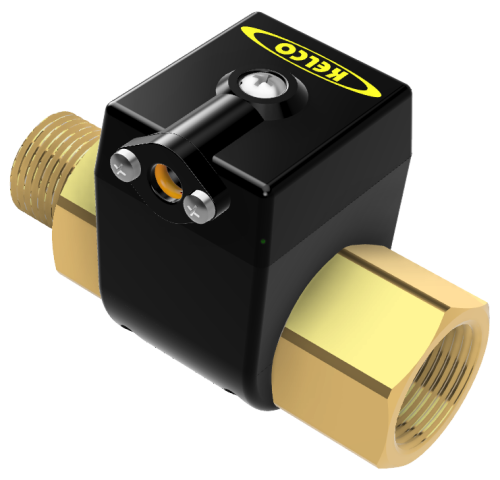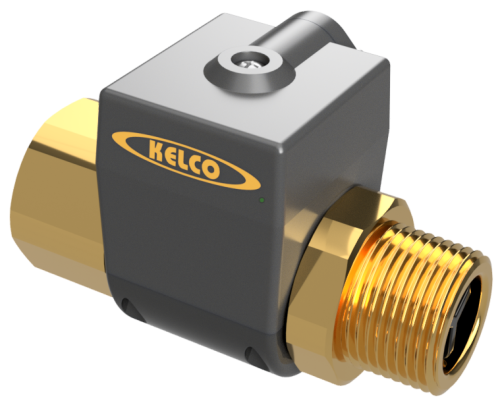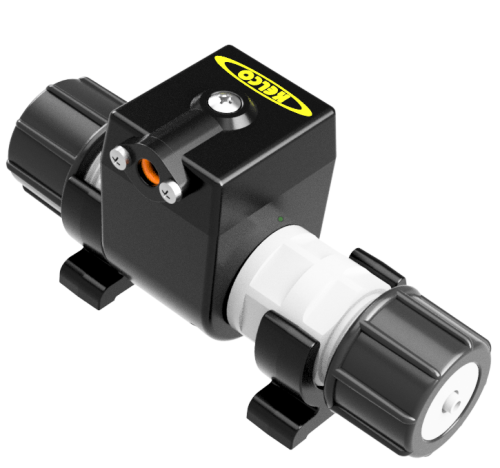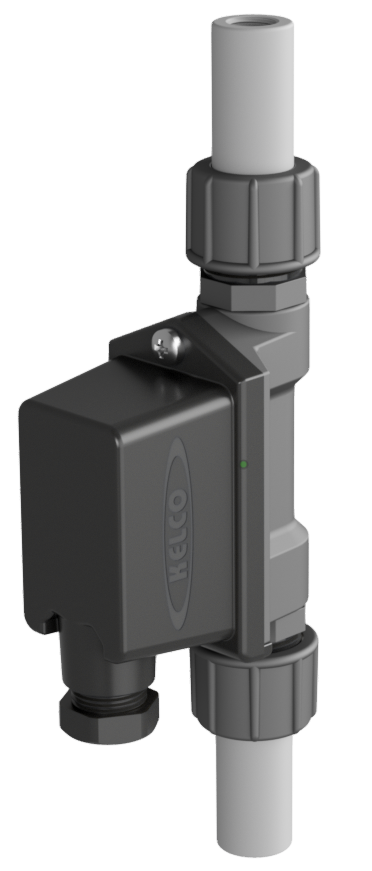
Simple, reliable inline flow switch for liquids or gases in tubes and small-diameter pipes. Detects continuous or pulsed flows, with no metal parts in contact with the liquid — ideal for sea water, ground water, acids and chemical solutions.
P20 Series
Inline Flow Switches
Features
- Detects very low flows (P20-B and P20-R switch off at 0.065 L/min)
- No metal parts in contact with the liquid
- All-position mounting
- Easy to install
- High flow-through capability
- 18 bar pressure rating
- Very low head loss
- Liquid or gas flow detection
- 0.14 L/min switch-on flow (P20-B and P20-R)
- Liquid pH range 1 to 14
- 3 electrical modules — reed switch or solid state relay outputs
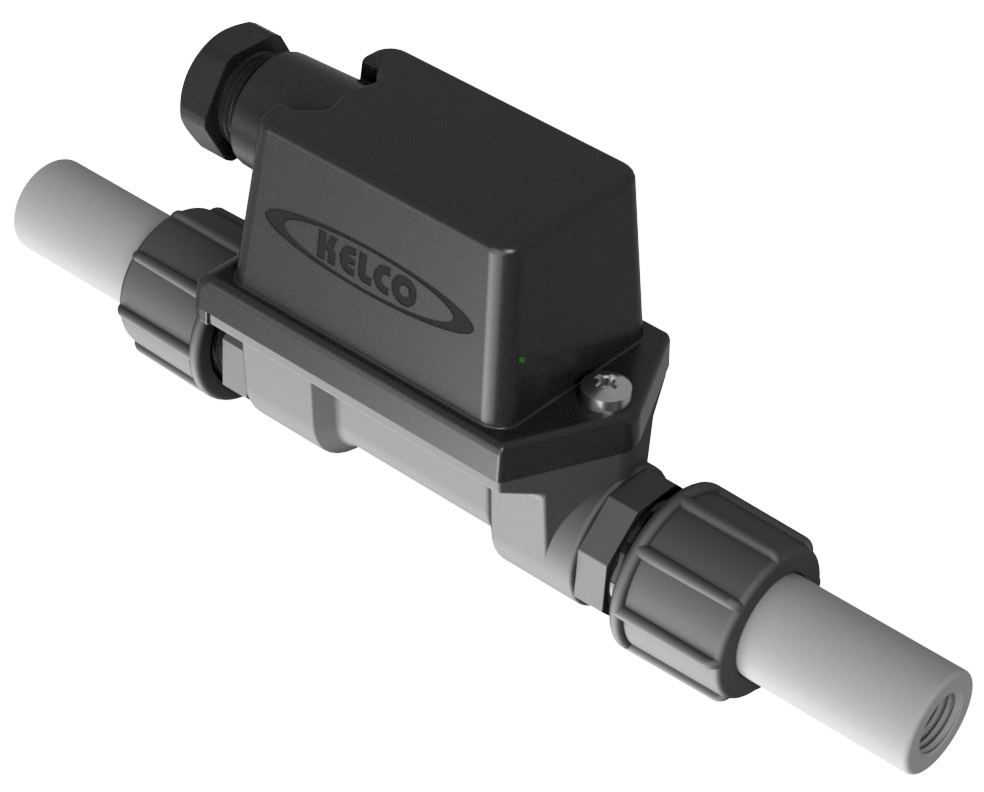
The P20 body houses a fluted piston. Any flow pushes the piston back within the body until the liquid passes over and out of the switch. The piston contains a magnet that actuates an external reed switch through the polypropylene wall. When flow stops a second magnet built into the body returns the piston to the off position — a magnetically-sprung mechanism that is exceptionally reliable and corrosion-proof. All-position mounting (including upside-down). Three electrical modules give a wide choice of control options. The standard P20 is made entirely from glass reinforced polypropylene with nitrile O-ring seals, and is supplied complete with pipe spigots and unions for direct fitting into PVC or ABS pipework.
Select Model
Trade customers should contact sales@kelco.co.nz for account pricing.
Ordering — Available Models
| Model Number | Description |
|---|---|
| P20-B-20 | Dry reed switch S.P.S.T. N.O. — 50 W/VA, 250 V AC / 200 V DC, 1.5 A max. Not suitable for inductive loads. PLC and general control circuits. 20 NB process connection (suits PVC pipe). |
| P20-C-20 | Dry reed switch S.P.D.T. break before make — 20 W/VA, 140 V AC / 150 V DC, 1 A max. Not suitable for inductive loads. PLC and general control circuits. Less sensitive than B/R — < 0.50 L/min activation. 20 NB process connection (suits PVC pipe). |
| P20-R-20 | Solid-state relay (triac) S.P.S.T. N.O. — 740 W, 12 to 240 V AC, 4 A continuous (spike to 15 A); inductive loads 4 A at 240 V AC. AC control circuits and AC motor control. 20 NB process connection (suits PVC pipe). |
Operating Limitations
| Switching point on rising flow (P20-B / P20-R) | 0.14 L/min (water at ambient) |
|---|---|
| Switching point on falling flow (P20-B / P20-R) | 0.065 L/min (water at ambient) |
| Switching point on rising flow (P20-C) | < 0.50 L/min (water at ambient) |
| Switching point on falling flow (P20-C) | 0.30 L/min (water at ambient) |
| Electrical response time (cessation of flow) | 0.4 seconds |
| Maximum operating pressure (static or dynamic, ambient) | 1800 kPa / 261 psi |
| Minimum burst pressure (ambient) | 9700 kPa / 1406 psi |
| Maximum liquid temperature | 80 °C at 1 bar absolute (de-rate pressure linearly) |
| Minimum liquid temperature | -30 °C |
| Maximum recommended continuous flow rate (water) | 25 L/min |
| Liquid pH range | 1 to 14 |
| Ingress protection rating | IP67 |
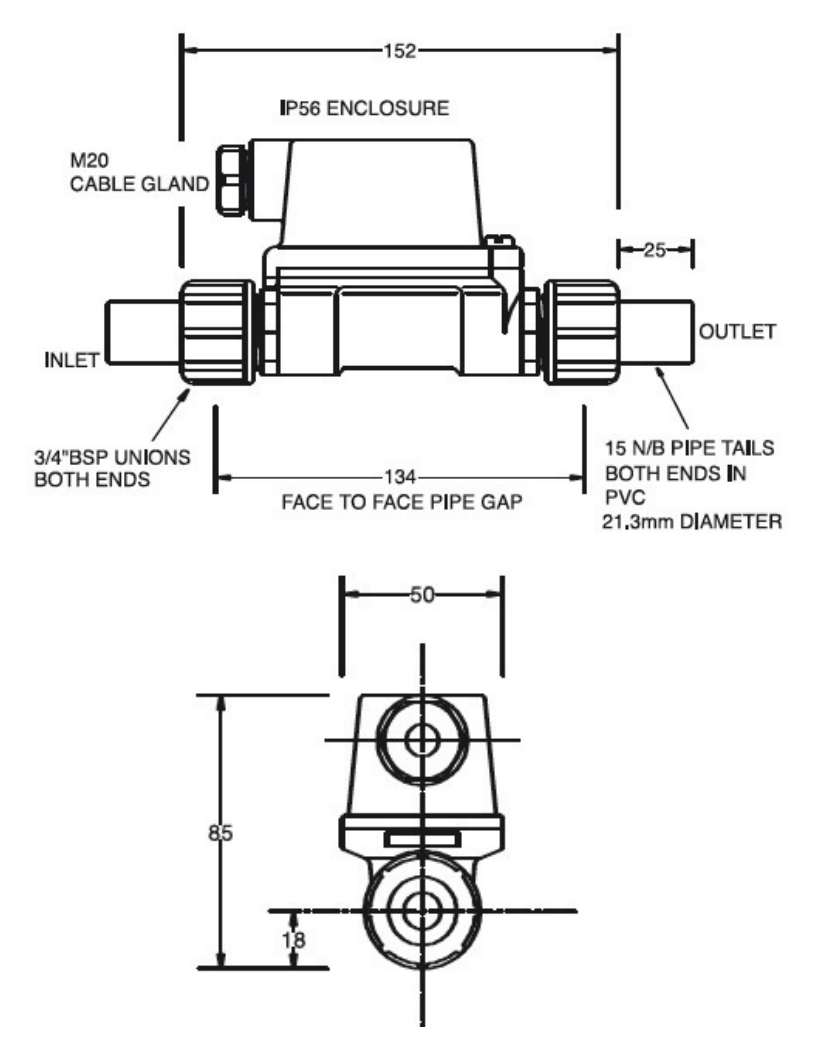
Dimensions
Warning: Electrical Safety
The P20 Series flow switch is a mains voltage device. Death or serious injury may result if this switch is not correctly installed and operated. All electrical work on this switch must be performed by a fully qualified and licensed electrician.
Pressure De-rating at Elevated Temperatures
The 1800 kPa max operating pressure applies at ambient. Maximum operating pressure must be de-rated linearly with temperature, to a maximum of 1 bar absolute at 80 °C. Use this switch at elevated temperatures only in non-pressurised systems open to atmosphere.
All-Position Mounting
The P20 can be mounted in any orientation in pipework, including upside-down, with no adverse effects — the magnetically-sprung piston (rather than gravity) returns it to the off position when flow stops. There is a direction of flow arrow on the switch body; the switch will not operate against a reversed flow. Pipework can be used to support the switch, or the switch can be connected directly into valve manifolds or pump ports.
Liquid or Gas Flow
The P20 can detect the flow of liquids or gases, including vapour flow. Maximum temperature is 80 °C, and at 80 °C the operating pressure must not exceed 1 bar absolute.
Clean Fluid & Line Filtration
The P20 contains a close fitting piston and should only be used where the process fluid is reasonably clean and free of entrained or suspended material. Fluids containing large particulate matter, ferrous materials or fibrous matter should not be used in this switch. If the degree of contamination of the process fluid can’t be guaranteed, fit suitable line filtration upstream of the P20.
Pressure Limits & Water Hammer
Do not use the P20 where the line pressure exceeds 18 bar. In the interest of safety the switch has a burst pressure rating of >97 bar. Take care not to expose the switch to excess pressures such as may be generated by water hammer.
Materials & Housing
The standard P20 is made entirely from glass reinforced polypropylene with nitrile O-ring seals. The piston return and the electrical switching action use high power magnets operating through the solid body of the switch. The electrical housing is hose-proof and weatherproof to IP67 — dust tight, protected against temporary immersion and suitable for all outdoor exposed applications — with a built-in 20 mm cable gland for conduit or flexible cable entry (flexible cable up to 10 mm diameter, or a 20 mm conduit bush with the gland nut removed). Protect the switch from freezing.
Lid & Cable Gland
After installing or servicing, always replace the lid and fully tighten its lid screw and the cable gland. Never leave the lid off for extended periods: without its lid the switch is not water resistant or weather and insect proof and presents a potential shock hazard.
Typical Applications
Constant pressure pump control, loss of prime pump protection, water treatment control, irrigation control, chemical dosing systems, gland cooling systems and industrial process control.
Hazardous Areas
The P20-B and P20-C are simple apparatus under AS/NZS 60079.11 and may be used in a hazardous area only as part of an intrinsically safe circuit, connected through suitably certified associated apparatus. They are not Ex certified in their own right. The full conditions of use are given in the installation sheet. The P20-R is not certified for use in hazardous areas and must not be installed in any area classified as hazardous under AS/NZS 60079.10 (Zone 0, 1, 2, 20, 21 or 22).
Serviceability
Fully field-serviceable. The electrical circuit boards are interchangeable and all parts of the P20 are available as spare parts; many of the parts are interchangeable, allowing custom configuration of the switch. Spare kits and seals available from Kelco Engineering or your distributor.