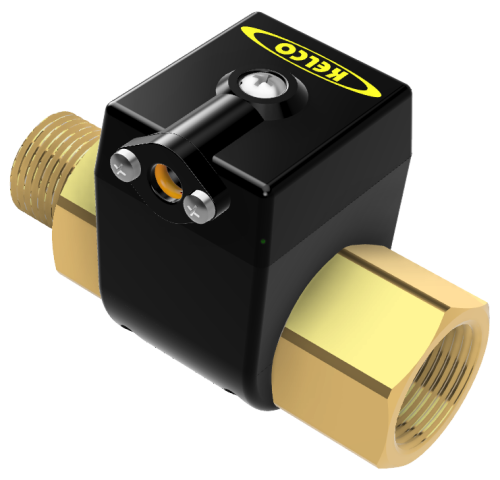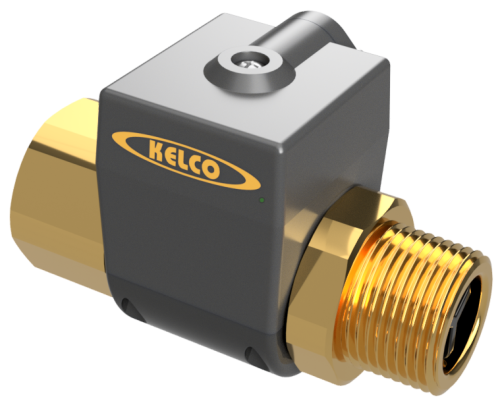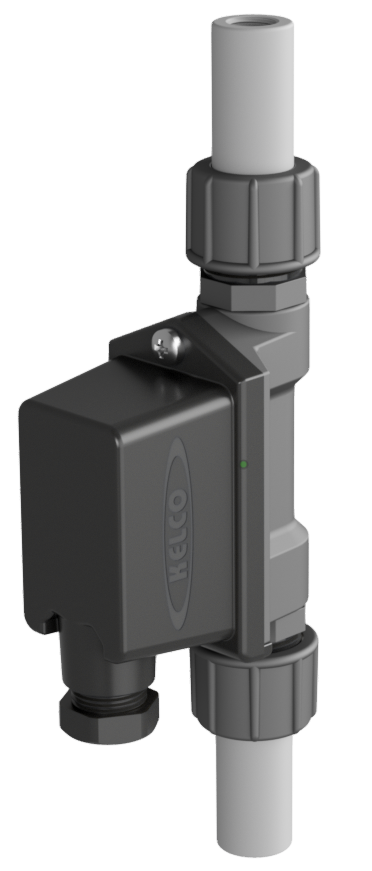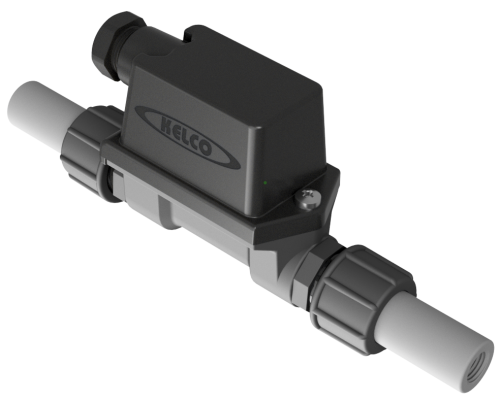
Compact inline flow sensor designed to detect very low flows — less than 500 mL per hour. Ideal for loss-of-flow detection in chemical metering and injection systems. PVC body with Viton seals; suits commonly used water-treatment reagents.
CR22 Microflow
Inline Flow Switches
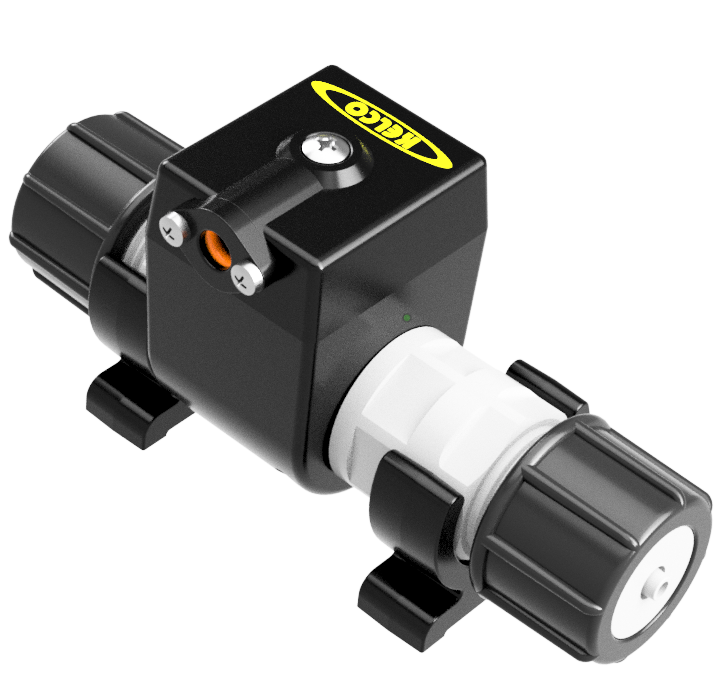
Features
- Detects flows of less than 500 mL per hour
- Maximum continuous flow rate of 4 L/min
- Suitable for pulsed or continuous flows
- Suits tubes and pipes from 6 mm to 20 mm
- All wetted parts UPVC with Viton seals
- Compact vertical-mount switch
- 18 bar (260 psi) pressure rating
- Fast response to flow loss
- Easy to install and service
- Weatherproof
The CR22 operates on the displaced-piston principle. Process liquid passing upward through the switch lifts a precision piston; each time the piston is lifted a magnet sealed inside it actuates an external reed switch. The CR22 can be set up as a normally on or a normally off switch that responds either to flow, or to loss of flow. As supplied it is normally off, switching on in response to flow; reversing the inlet and outlet adaptors reverses this function.
More Information
Select Model
Trade customers should contact sales@kelco.co.nz for account pricing.
Ordering — Available Models
| Model Number | Description |
|---|---|
| CR22 | PVC body switch with dry-contact reed switch and Viton O-ring seals |
Operating Limitations
| Switching point on rising flow (water at ambient temperature) | < 500 mL per hour |
|---|---|
| Response to loss of flow (water at ambient temperature) | 2 seconds ±15% |
| Maximum recommended operating pressure (static or dynamic) at ambient temperature | 1800 kPa / 260 psi |
| Minimum burst pressure at ambient temperature | 9700 kPa / 1400 psi |
| Maximum process liquid temperature | 60 °C |
| Minimum liquid temperature | 0 °C |
| Maximum recommended continuous flow | 4 L per minute |
| Liquid pH range | 1 to 14 |
| Maximum process liquid SG | 1.5 |
| Minimum process liquid SG | 0.8 |
| Weatherproof rating of electrical module | IP56 |
| Head loss at 2 L/min flow (water at ambient temperature) | 40 kPa |
Electrical Data
| Module type | Dry-contact reed switch |
|---|---|
| Contact configuration | S.P.S.T. NO or NC |
| Switched power (maximum) | 50 W/VA |
| Switched voltage (maximum) | 250 VAC / 200 VDC |
| Switched current, resistive AC RMS (maximum) | 1.5 A |
| Inductive loads | Not suitable — use a relay or interposing contactor |
| Typical application | PLC, telemetry and relay logic circuits |
| Reed switch operating life | In excess of 100 million cycles (care needed to avoid electrical overload) |
Dimensions
Hazardous Areas
The CR22 is simple apparatus under AS/NZS 60079.11 and may be used in a hazardous area only as part of an intrinsically safe circuit, connected through suitably certified associated apparatus. It is not Ex certified in its own right. The full conditions of use are given in the installation sheet.
Orientation — must mount vertically
The CR22 must be oriented vertically with flow passing upward through its body. The switch relies on gravity to return its internal piston to the off position when flow stops. If installed in horizontal pipework it will not switch off when flow stops.
Normally-On or Normally-Off
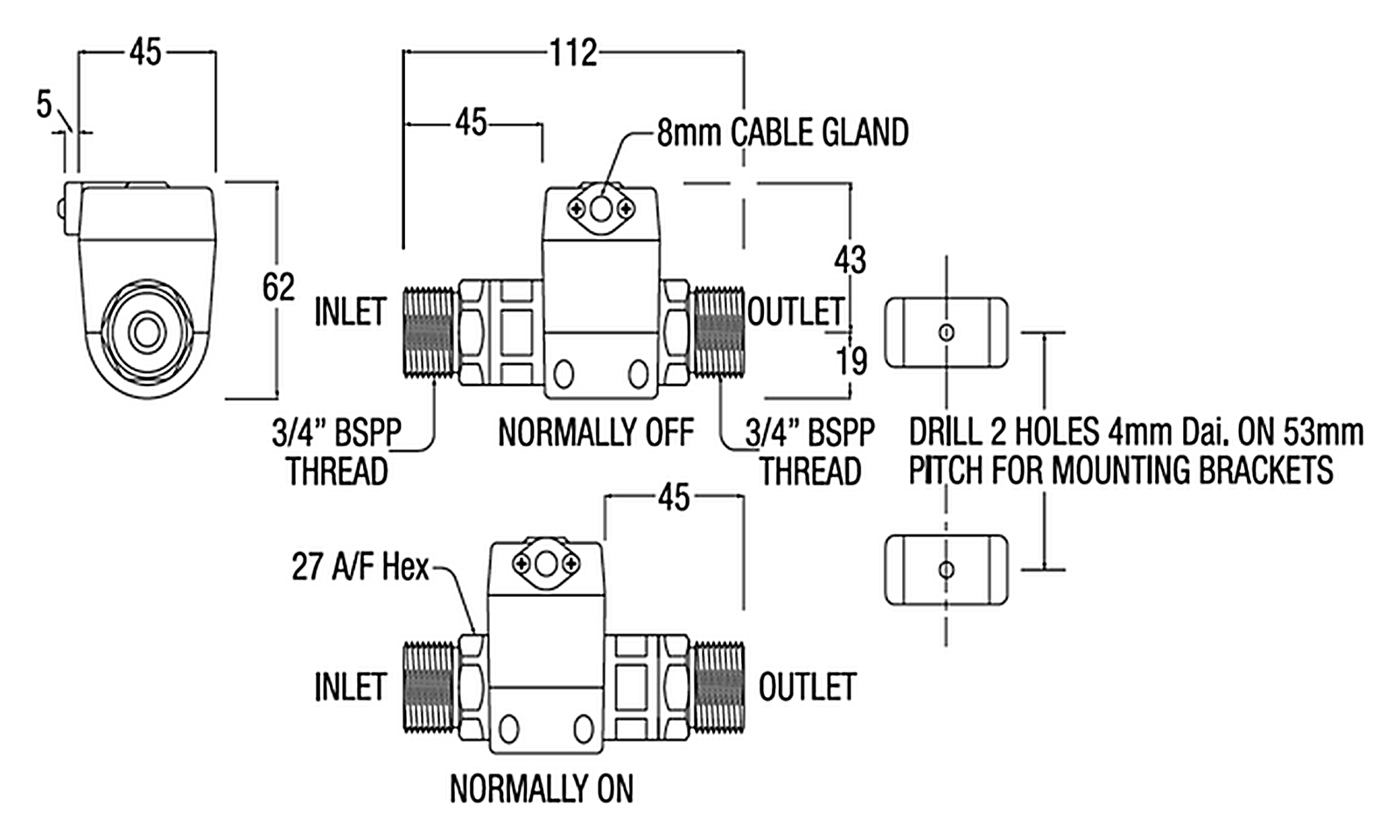
As supplied, the CR22 is normally off and switches on in response to flow. To reverse the function simply unscrew the inlet and outlet adaptors (parts 5 and 6 on the spare parts list) and reassemble with them swapped. The electrical module can also be removed and reversed so the cable enters from either side; reversing the module does not change its electrical function. The electrical module is a slip fit on the switch body and can be rotated to any required position without affecting operation.
Compatible Liquids
Suits clean liquids free from suspended solids larger than 30 µm and free from particulates or sludge residue that may be attracted to magnets, including most mineral salts, many acids and bases. The wetted parts are UPVC with Viton O-ring seals, with no metal parts in the wet area. ‘Ferric solutions, organic solvents, esters and ketones’ in general should not be used. Not suitable for highly viscous liquids or liquids containing materials that tend to crystallise.
Viscosity and Specific Gravity
The sensitivity to flow is not adjustable. In general, liquids of an SG > 1.0 or kinematic viscosity of > 1.0 proportionally increase the sensitivity of the switch and slow down its response time, so less flow is needed to actuate it. Low SG and low viscosity liquids have the reverse effect: the switch is less sensitive, needs a proportionally higher flow to actuate, and responds proportionally faster.
Pulsed-Flow Behaviour
When connected directly to a dosing pump the CR22 normally receives a train of liquid pulses. If the pulse frequency is greater than one every 2 seconds, the switch provides a steady output state. If pulses are slower than one every 2 seconds the switch may respond with a series of on/off signals proportional to the dosing pump’s pulse frequency. When the liquid stops flowing the switch changes state after a delay that depends on the process liquid’s viscosity; for water the delay is approximately 2 seconds.
Installation
Mount in a dosing system directly onto the pump discharge valve, on an adjacent wall or backing board, or directly onto an injection point; mounting at an injection or discharge point makes the switch indicate loss of flow for the whole system, including the pump’s discharge pipework and valves. Two mounting clips are supplied: drill 2 holes 53 mm apart and fix with 4 mm stainless screws (not supplied). For rigid PVC pipework use the PVC pipe spigots, taking care that no solvent or glue enters the switch body. Do not over-tighten the union nuts or the inlet and outlet adaptors, because the switch is sealed by O-rings and over-tightening the inlet adaptor may distort the body and jam the piston. Purge pipework before installing and, if necessary, fit a 30 micron filter on the inlet side. Do not install the CR22 on the suction side of a dosing system, as its flow restriction may cause the pump to cavitate or fail to prime.
Process Liquid Temperature
The operating limits are 0 °C to 60 °C, but in the interest of safety the CR22 should only be used with process liquids that are at or close to ambient temperature.
Reed Switch Protection
The CR22 uses a dry contact reed switch as its primary switching element. Reed switches offer an operating life in excess of 100 million cycles, but care needs to be taken to ensure they are not electrically overloaded. If applied in questionable applications, suitable protection should be added to the control circuit.
Electrical Work
The CR22 microflow switch is a mains voltage device. All mains voltage electrical work must be performed by a fully qualified and licensed electrician and conform to AS/NZS (or equivalent) standards and local wiring rules.
Serviceability
The CR22 is field-serviceable. The reed-switch electrical module can be removed and reversed, and the spare parts list covers the sensor head, body, piston, Viton O-rings, inlet and outlet adaptors, union nuts, pipe spigots, tube adaptors and wall mounting brackets. Spare parts including replacement seals and pistons available from Kelco Engineering or your distributor.